October 23, 2026
How does pest control work? Industry standards, transparency and what to expect
Short answer: Good pest control is a process, not a spray. A licensed technician inspects first, identifies the pest and how it’s getting in, then applies the right product in the right place, following the label. The process includes follow-up visits and a written record of what was done. When pest control fails, it’s usually because one of those steps was skipped.
Most people only think about pest control when something is crawling across the kitchen floor. Then they call a company, someone shows up, and a few weeks later the problem is either gone or it isn’t. It helps to know what is supposed to happen during a visit, what the rules are in Florida, and where service usually goes wrong, whether you hire us or anyone else.
How professional pest control works, step by step
1. Inspection
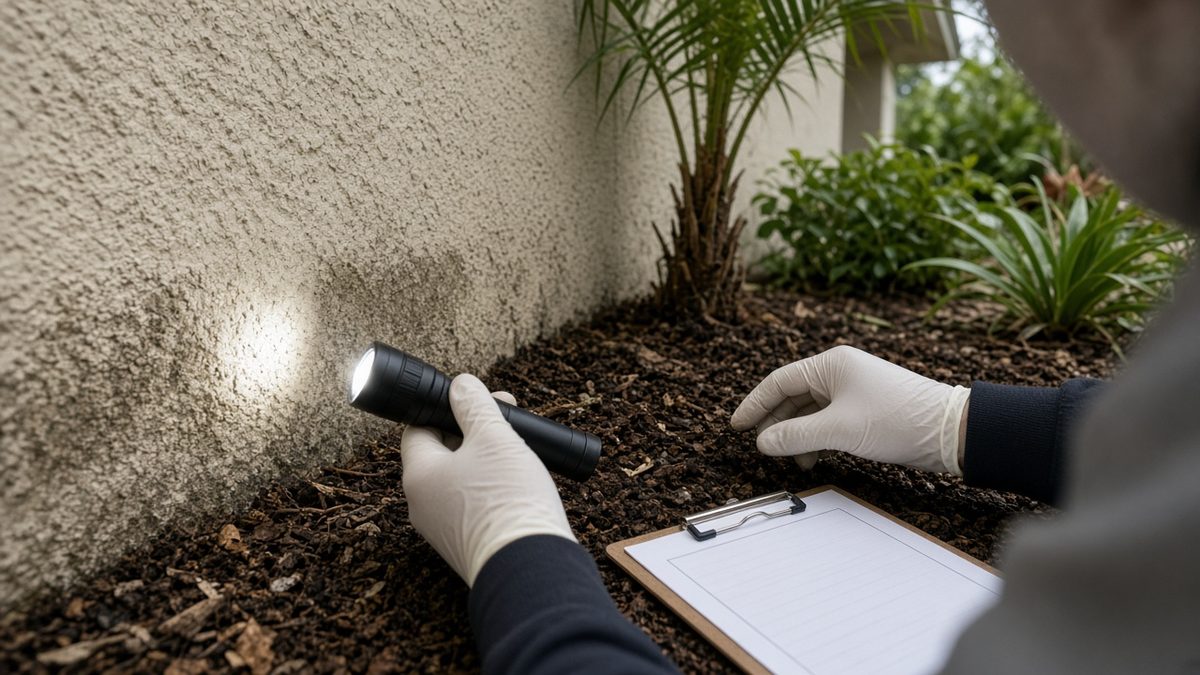
Every good service starts with looking, not spraying. The technician checks the places pests live, feed and enter: under sinks, around plumbing, door sweeps, window frames, the attic, the garage, the landscaping against the house and the roofline. In South Florida that also means checking mulch beds, palm trees and irrigation leaks, because moisture drives most of our pest problems.
2. Identification
Different pests need different treatments. Ghost ants, big-headed ants and fire ants are all “ants”, but they don’t respond to the same baits. A palmetto bug living outdoors is a different problem from German cockroaches breeding in a kitchen. Getting the identification right is what makes the rest of the plan work. Our pest library shows the common Palm Beach County pests.
3. A treatment plan
The plan explains what will be treated, where, with what type of product, and why. It also includes what you can do: fixing a leak, trimming shrubs off the walls, sealing a gap under a door. This approach is called integrated pest management (IPM). It’s the standard taught by UF/IFAS and recommended by the EPA, and it combines prevention, monitoring and targeted treatment instead of relying on chemicals alone.
4. Treatment, following the label
Treatments are matched to the pest and placed where they’ll work: baits where ants forage, crack-and-crevice treatments where cockroaches hide, exterior treatments around the foundation. Every pesticide label is a legal document. The product must be used exactly as the label directs, including where it can go and how much.
5. Follow-up and monitoring
Many pests take more than one visit. Eggs hatch, colonies relocate and new pests move in with the seasons. A follow-up visit confirms that the treatment worked and adjusts the plan if it didn’t.
6. A written service report
After each visit you should get a record of what was found, what was applied and where, and any recommendations. That record is useful to you, to your HOA or property manager, and to the next technician.
Industry standards in Florida
- Licensing. Florida’s pest control law (Chapter 482, Florida Statutes) requires pest control businesses to be licensed by the Florida Department of Agriculture and Consumer Services (FDACS), with work performed under a certified operator. You can look up a company’s license with FDACS.
- Certification categories. Operators are certified in specific categories, such as general household pests and rodents, termites and other wood-destroying organisms, lawn and ornamental, and fumigation.
- Labels are the law. Products must be applied according to their EPA-registered labels.
- Written contracts for termite work. Florida law sets requirements for written contracts on termite and wood-destroying organism treatments, so ask for one and read it.
What transparency should look like
You should never have to guess what was done in your home or business. A transparent pest control company will:
- Tell you what pest it found and how it’s getting in.
- Explain the plan and the products it will use, and any precautions for kids, pets or employees.
- Leave a written service report after each visit.
- Make it easy to reach someone and report a problem, and then actually respond.
- Show its license number and the certified operator responsible for the work.
Common pest control service failures
These are the problems we hear about most often when people switch companies:
- No inspection. The technician sprays the baseboards and leaves without looking for the source.
- Wrong identification. A treatment that works for one ant species does little for another.
- Same treatment every visit. The plan never changes, even when the problem does.
- Treating symptoms, not causes. Leaks, gaps and harborage are never mentioned, so pests keep coming back.
- No follow-up. One visit, then nothing until the next scheduled date.
- No records. Nobody can say what was applied, where or when.
- Hard to reach. Complaints go into a voicemail box and nothing happens.
Our guide on how to choose the right pest control company has a checklist of questions to ask before you sign up.
What sets Q and L Pest Management apart
- A complimentary inspection first. We look before we recommend anything.
- Written service reports. Every visit is documented so you know what was done.
- Work orders and complaint handling. For HOAs, property managers and businesses, we schedule, service and document every request. See our programs for associations and property managers.
- Options for homes with kids and pets. We use reduced-risk products, reviewed before use, and we’ll explain any precautions. Learn more about our pet- and kid-friendly approach.
- Licensed and certified. Q and L Pest Management LLC holds FDACS Pest Control Business License #JB333443, and services are performed under Certified Pest Control Operator John Park, certificate #JF320165, certified in all four major Florida pest control categories.
- Local. We’re based in Lantana and serve Palm Beach County, from Jupiter to Boca Raton, with office hours Monday to Friday, 8 AM to 4 PM.
Whether it’s home pest control, commercial pest control for your business or termite treatment, the process is the same: inspect, identify, treat, follow up and document.
Frequently asked questions
How long does a pest control treatment take to work?
It depends on the pest and the treatment. Some baits take days to work through an ant colony, while other treatments act faster. Your technician should tell you what to expect and when to call if activity continues.
Do I need to leave my home during treatment?
For most routine treatments, no. If a product or method requires you to stay out of an area for a time, we’ll explain any precautions before we start. Fumigation is different and requires everyone to leave.
How often should pest control be done?
That depends on the property and the pests. Many homes in South Florida use a recurring schedule because of the climate, while some problems only need a one-time treatment and follow-up. The inspection is where that gets decided.
How can I tell if a pest control company is licensed in Florida?
Ask for the business license number and the certified operator’s name, then check them with FDACS. Our license is #JB333443.
What should be in a pest control service report?
What was found, what was applied and where, the date and the technician, and any recommendations for you or your property manager.
Request a complimentary inspection
Book a complimentary inspection and we’ll share what we find, explain your options and recommend a plan for your home.
Request a complimentary inspection: qandlpest.com/contact-us/ · (561) 725-5274
Office hours: Mon–Fri 8:00 AM–4:00 PM.
Inspect first. Treat smart.
About the author
Michael Ringler, Q and L Pest Management. Q and L Pest Management is a family-owned pest control company based in Lantana and serving Palm Beach County since 2022.Q and L Pest Management LLC holds FDACS Pest Control Business License #JB333443. Services are performed under FDACS Certified Pest Control Operator John Park, certificate #JF320165.
Sources
- Florida Statutes, Chapter 482, Pest Control: flsenate.gov
- FDACS, Pest Control licensing: fdacs.gov
- U.S. EPA, Introduction to Pesticide Labels: epa.gov
- U.S. EPA, Introduction to Integrated Pest Management: epa.gov
- UF/IFAS Integrated Pest Management: ipm.ifas.ufl.edu